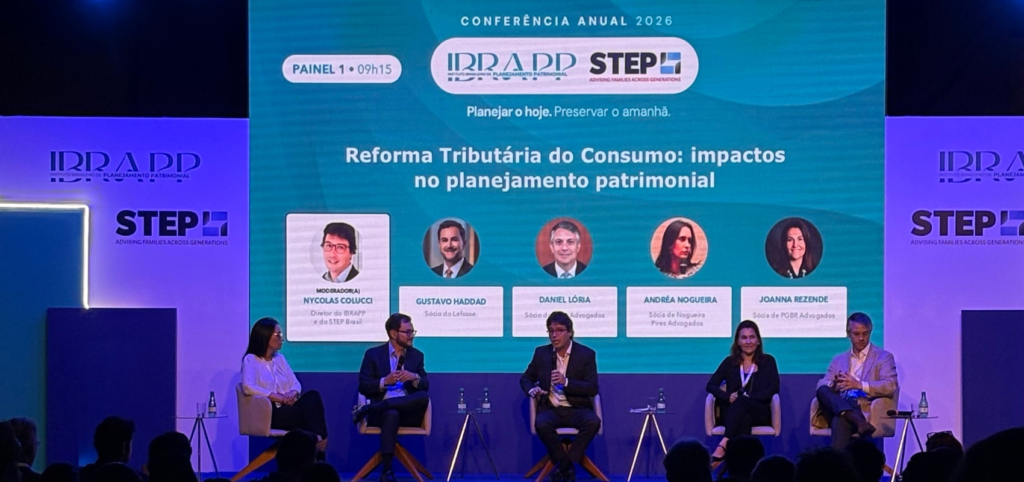
On Friday, August 28, the IBRAPP Annual Conference 2026 was held at the Bienal do Ibirapuera in São Paulo, one of the most relevant gatherings on Brazil’s wealth planning and succession calendar. The event was jointly organized by IBRAPP (Instituto Brasileiro de Planejamento Patrimonial, Sucessório, Governança Familiar e Estudos Tributários) and STEP Brasil, and brought together lawyers, tax specialists, private bankers, family office representatives, and private wealth advisors from across the country. OMC Group took part in the day through Julia Espínola, a member of the company’s team dedicated to the Brazilian market.
Over the course of the day, panel discussions addressed the principal legal, tax, investment, and succession planning developments currently reshaping the Brazilian market.
The Consumption Tax Reform Opens the Day
The first panel of the day addressed the Brazilian Consumption Tax Reform and its impact on wealth and estate planning, moderated by Nycolas Colucci, Director of IBRAPP and STEP Brasil, with panelists from Lefosse, Lória Advogados, Nogueira Pires Advogados, and PGBR Advogados.
The timing was fitting: 2026 is the year this reform moved from proposal to operational reality for Brazilian businesses. The country is now in a gradual implementation phase, in which the new system runs alongside the previous tax rules while the broader timeline advances toward replacing several federal, state, and municipal taxes with a unified consumption tax framework. For the wealth planning sector, this means a period of adjustment that calls for close monitoring, both by companies and by their advisors.
Family Business Succession and the New ITCMD Framework
The agenda continued with succession strategies for family-owned business groups, centered on governance, continuity, and long-term wealth preservation. Within this discussion, the ITCMD — Brazil’s inheritance and gift tax — once again took center stage.
For years, the way this tax was calculated varied considerably from one state to another, giving families wide latitude to shape their succession strategy around where their wealth was based. That latitude is narrowing: Brazil is moving toward more uniform and more demanding criteria for calculating the tax, alongside stricter valuation of the business assets involved in an inheritance or gift. Panelists agreed this is not a one-off shift but an ongoing process that will keep deepening in the years ahead.
Income Tax Reform, Dividends, and International Structures
Subsequent panels turned to two of the topics most closely followed by the sector at present: the proposed Income Tax Reform — covering changes to dividend taxation, individual income taxation, offshore structures, and exclusive investment funds — and wealth planning through asset segregation via international structures.
Speakers reviewed the main changes Brazil has introduced in recent years to the taxation of profits and dividends, both for residents and for those receiving distributions from abroad, as well as the new minimum tax rules applicable to higher incomes. Reference was also made to the growing reporting requirements facing offshore structures and foreign trusts, which have expanded year after year.
A Market in Constant Transition
A theme that ran through several of the panels was the pace of change: Brazil’s tax reforms — spanning consumption, income, and succession — are advancing simultaneously, and a number of speakers noted that this leads families, entrepreneurs, and investors to review their asset protection and international structures more frequently. Offshore structures remain a common part of Brazilian families’ wealth planning, and several panels touched on the importance of keeping them current with Brazil’s evolving reporting requirements.
OMC Group’s Presence
As a fiduciary agent giving Brazilian clients access to international structures, products, and services, remaining close to how local advisors, private bankers, and family offices interpret these reforms is essential for OMC Group. This proximity to Brazil’s wealth planning ecosystem allows the company to ensure that its own international solutions remain aligned with the realities and evolving needs of the market it serves, and is now reinforced by the opening of its own office in Brazil.
Building relationships across international markets.